1

Taking Addiction to the MAT: Why It’s Time to Embrace Medication-Assisted Treatment

With the number of opioid-related overdose deaths in the U.S. reaching a record high last year, it’s time for our nation to fully embrace evidence-based treatment options that best support our communities, loved ones, friends and families in their recovery efforts.

One growing approach—often considered as the gold standard of treatment—is medication-assisted treatment (MAT). MAT is the use of FDA-approved medications in combination with counseling and behavioral therapies to provide a holistic, person-centered approach to the treatment of substance use disorders (SUDs). The use of this treatment approach has grown to nearly 40 percent in residential facilities and is increasingly leveraged by primary care providers nationwide—but more still must be done for widespread adoption.

The most pervasive stigma surrounding MAT is that it merely enables patients to replace one addiction with another. It’s a belief held not only by some groups of doctors and clinicians, but also family members and peer support groups—those whose support is critical to successful recovery. When a patient’s core support system of family members and peers doubts the legitimacy of an evidence-based form of treatment, the likelihood that the patient will follow through long-term is diminished.

Pair that with a lack of understanding and comfort from the medical community around how to administer MAT, limited numbers of physicians who are certified to prescribe this treatment that actually do prescribe the treatment, as well as the number of residential facilities that offer MAT, and we get low adoption rates as a result of these barriers.


There’s a better way to treat opioid use disorder

Although abstinence-based therapy works for a small percentage of those suffering from OUD, MAT offers a successful way for people to fight their addictions in an outpatient environment, in the community in which they live, and avoid hospitalization or institutionalization. It helps those struggling with OUD and other SUDs address underlying conditions that may have contributed to substance abuse—significantly improving the chances of recovery. In one study, more than half of patients utilizing MAT reported opioid abstinence 18 months after beginning treatment.

Today, while 900,000 U.S. physicians prescribe opioids, fewer than 35,000 physicians are certified to prescribe buprenorphine, one of three medications approved to treat opioid addiction. And even fewer actually prescribe buprenorphine to patients. MAT prescribing is not limited to psychiatrists. In fact, primary care providers provide more access to MAT than any other type of provider.

The impact of limited access to MAT on health outcomes cannot be overlooked. One analysis found only one-third of individuals who experienced a nonfatal opioid overdose received access to MAT. Those who received methadone were linked to a 59 percent decrease in mortality rates after one year, according to the analysis. Additionally, individuals who were treated with buprenorphine were associated with a 38 percent decrease in mortality after a year.


Increasing Access to MAT

The SUPPORT for Patients and Communities Act, signed in October 2018, expands the ability to prescribe MAT by increasing clinician eligibility for certification. This provision is a solid and necessary step toward broadening access to treatment; however to make a true impact on the opioid epidemic, we must break the stigma surrounding MAT.

When it comes to recovery, the potential for relapse is high, especially in the early stages when resolve is fragile. It is important to note that for individuals with co-occurring mental health conditions, chronic pain or other addictions, MAT should be supplemented by treatment for those conditions, such as cognitive behavioral therapy. Building in care management support to assist in navigating the treatment process may reduce the possibility of relapse and/or readmission to a substance abuse inpatient or residential rehabilitation program. It also helps provide individuals with the tools needed to live addiction-free.

By taking the time to dispel the myths about non-traditional addiction treatment like MAT, we create an environment that more fully supports a return to complete health—physical, mental and emotional. Fighting the stigmas around MAT is an important step toward enabling those suffering from OUD to recover from their addiction and live healthy, vibrant lives.


Automating Prior Authorization at the Point of Care

For healthcare providers, prior authorization (PA) via fax or telephone is the second most costly medical administrative function. On average, medical staff spend two business days per week on PA. Automating PA while maintaining clinical excellence is essential for better care delivery. With a focus on leveraging digital solutions and fostering data-enabled decisions, Magellan Healthcare is building more provider-friendly approaches to improve care.

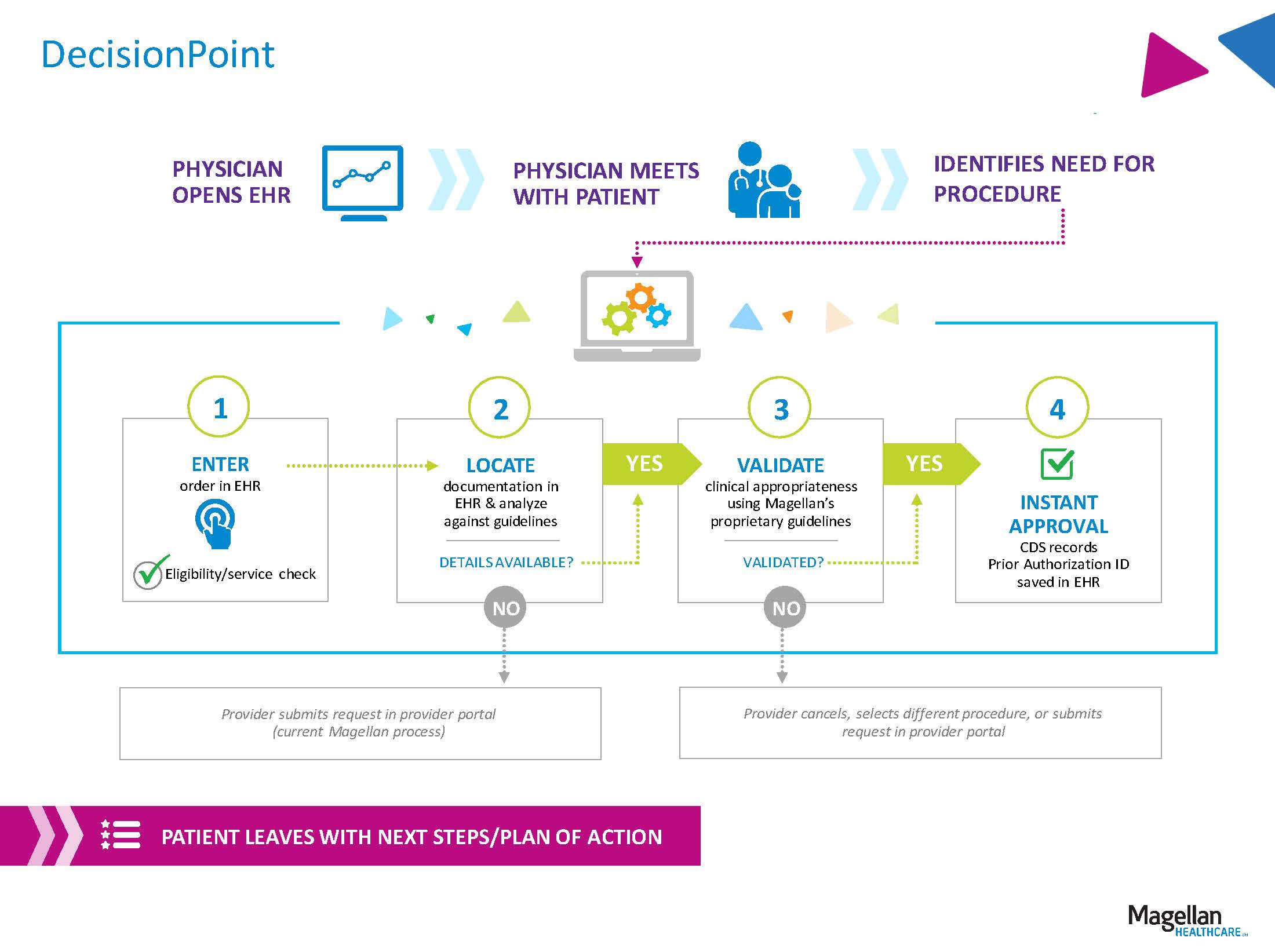
Recently Magellan announced a collaboration with Stanson Health, Premier, Inc.’s clinical decision support (CDS) technology division, to deploy DecisionPoint, an industry-leading automated PA solution. Powered by Premier’s CDS technology, DecisionPoint is available at the point of care and supports true automation within the electronic health record (EHR) and the physician workflow, making the PA process easier and more efficient for providers, patients and health plans.

DecisionPoint is built with Magellan Healthcare’s Advanced Imaging Management program clinical guidelines and Premier’s award-winning technology platform. Magellan maintains one of the industry’s most comprehensive evidence-based sets of clinical guidelines. Our clinicians develop our criteria through an extensive process of innovation and refinement. We base these guidelines on the analysis of public, peer-reviewed articles; health plan medical policies; the Centers for Medicare & Medicaid Services (CMS) policies; specialty physician reviews, professional society guideline statements; and other rigorous reviews of scientific documents. We continually monitor peer-reviewed literature, professional society guideline statements, and CMS-covered criteria to update our guidelines regularly, no less than annually. Initially, DecisionPoint will include our suite of the 20 highest-volume advanced imaging studies that make up 85% of all requests.

Working directly in the EHR, DecisionPoint guides provider decisions in real time in response to key workflow events, such as ordering an advanced imaging study. Integrating within the EHR improves efficiency while ensuring safety and quality and reducing undesirable variation in care.

Rules-based programming leverages EHR data, locating all relevant patient clinical information and citing appropriate Magellan clinical guidelines. Requests that satisfy the clinical guidelines are automatically approved and posted in the EHR, and approval IDs are automatically loaded to the record. With a confirmed authorization determination, the member leaves the appointment with a clear plan of action.

P317rev5_MHC_EnhancedCDSToolProcessGraphic

Hawai‘i Pacific Health (HPH), one of the largest healthcare providers in Hawai‘i, is leading the way in automating prior authorization by piloting DecisionPoint to help ensure their patients receive real-time, evidence-based decisions at the point of care whenever possible. Administered through HPH’s Accountable Care Organization (ACO) with over 800 physician members, the pilot leverages Magellan’s clinical guidelines and our full panel of clinical experts. We expect DecisionPoint to be available to additional providers in the fourth quarter of 2019 and include additional specialties and tests in the future.

The healthcare industry is in the midst of a significant paradigm shift as it transitions from a fee-for service model to value-based care. As a technology-augmented service backed by the support of providers, DecisionPoint is designed to minimize the industry’s challenges by fully integrating with EHRs at the point of care to enable faster PA and help deliver on the triple aim—improved quality, reduced cost and improved patient/provider experience.

To learn more about DecisionPoint, click here to go to our website, or email ProviderSolutions@MagellanHealth.com.


One Suicide is Too Many

One suicide is too many. Yet more than 47,000 Americans die each year as a result of suicide. Because suicide is the 10th leading cause of death in our nation, we at Magellan Health believe it is nothing short of a public health crisis. Thankfully many experts and organizations agree.

Recently, Magellan had the privilege to host a suicide prevention conference in Boise, Idaho. The free conference brought almost 200 local and national leaders together to exchange ideas, share successes and discuss solutions around the challenges we face together in addressing this crisis in our communities. Suicide is a topic that’s difficult, but we must talk about it and deal with it by creating an environment for genuine caring for one another. To have the greatest impact possible, this should start by encouraging those who are struggling to ask for help, and we need to remind one another to watch for signs and signals with our family, friends and colleagues.

The suicide crisis is particularly impacting the state of Idaho. In 2017, Idaho’s suicide rate was 22.9 per 100,000 residents. The state’s suicide rate is 58 percent higher than the national rate and reflects a 44 percent increase over the past 10 years.

During the conference, Dr. Michael F. Hogan, principal, Hogan Health Solutions, LLC, gave one of three keynote addresses. He spoke about opportunities to prevent suicide in all healthcare settings. As I shared in my remarks at the conference, I wholeheartedly agree with his perspective. From the examination room to the boardroom, healthcare leaders and executives play a critical role in helping solve this crisis. We must lead the charge—drawing in other key stakeholders like providers, lawmakers, teachers and family members to support efforts to make this crisis visible, reduce stigma and drive solutions.

One important place to start is by ensuring people understand the signs of suicide. First, we must increase education and awareness and promote community and statewide educational programs. We should focus on an audacious goal, a path to zero suicides, to drive the sense of urgency needed to get community-wide buy-in. In addition, we should invest in suicide training for family members and peers of those with a mental health diagnosis. Such training fosters early detection and, in the case of peer support, provides a common frame of reference, making individuals more likely to engage.

Second, we must work to break the stigma around mental health issues — and normalize the need for care. As Dr. Thomas Joiner, The Robert O. Lawton Distinguished Professor of Psychology at Florida State University, said during his keynote address, “Reach out and tell someone when you see that someone is desperate. These person to person connections as we look out for each other can have such a significant impact in reducing suicides. It is important to keep in mind that all of us hold an important role in caring for one another.” Creating opportunities for open dialogue in the community, like the workshops during our Boise conference, helps shine a light on the problem and engages more people in helping others before it’s too late.

Finally, improved access to care and early screening will go a long way toward reducing the risk of suicide. Ensuring people of all economic status and backgrounds have access to behavioral healthcare is key. However, finding specialists who are skilled in suicidology isn’t easy. One study in Maricopa County, Ariz., determined that only 30 percent of behavioral health professionals in the county believed they had the necessary skills and support to treat at-risk patients. We need increased funding for suicide training among all medical professions.

As many as 38 percent of people making a suicide attempt did so within a week of a healthcare visit. Our healthcare system must look for ways to support early detection by making depression screenings part of every primary care visit. To help identify patients with mental health conditions, Magellan Healthcare has developed SmartScreenerSM. SmartScreener is a digital application that contains standard screening tools used by behavioral health professionals like counselors, psychologists and psychiatrists. While the patient waits to be seen by the physician, he/she completes the screener. Answers are confidential and only shared with the physician, who will discuss the patient’s results during the appointment and can help with next steps.

This routine screening is making a difference in identifying patients with behavioral health concerns. In a six-month primary care SmartScreener implementation, approximately half of the patients screened positive for a behavioral health concern. About 38 percent were deemed appropriate to be referred to digital cognitive behavioral therapy (DCBT). Fifty-four percent of these appropriate patients then enrolled in DCBT, getting help for which they may otherwise never have been referred.

The path to zero suicides requires that healthcare leaders—and the nation as a whole—treat suicide as a public health crisis and that we normalize discussions about mental health, suicide and treatment. I hope everyone who attended our Boise conference left as inspired about the urgency of this issue as I did. Let’s all commit to strategies that involve our communities in suicide prevention and draw upon multiple resources for continuing education and improved access to treatment.


 For more information about suicide prevention, read our other blog articles here.


Is Prior Authorization in need of an Upgrade?

Prior authorization (PA) goes by many names—preauthorization, preapproval, advance notification, precertification and preadmission, to name a few. All these terms refer to the utilization management (UM) process used by many U.S. health insurance companies to ensure patients receive the right services, equipment and prescriptions at the right time and place. PA requires healthcare providers to request and obtain approval before rendering certain services, equipment or prescriptions in order to receive insurance reimbursement for those services. Not everything requires PA. Typically, authorization is needed for more complex services such as hospital admissions, diagnostic tests, medical equipment and complex prescription medications.

The PA process is intended to act as a safety and cost-saving measure. It can lower costs to the patient, prevent unnecessary or invasive procedures, and reduce the use of unnecessary tests that may expose patients to potentially harmful radiation and/or undue stress. For example, up to half of advanced imaging procedures ordered fail to provide information that improves patients’ welfare.[i] In addition, despite studies demonstrating overuse, rates of advanced imaging procedures continue to rise—increasing costs and exposing consumers to excessive radiation.  Despite its benefits, the prior authorization process needs an upgrade.

According to the 2018 CAQH Index , manual prior authorizations (via fax or telephone) are the second most-costly medical administrative transaction, costing providers $6.61 per submission. Providers estimate their staff members spend up to 30 minutes completing one manual prior authorization. While manual prior authorization is a much-debated topic due to the time and cost it requires, many parties support standardizing and simplifying the process.

Technology can significantly  decrease the need for expensive manual processes.  According to the 2018 CAQH Index, the medical industry could save $417 million annually by transitioning to electronic prior authorizations, which includes $278 million in annual savings for providers and $139 million for health plans.

While many health plans offer web portals to process prior authorizations, this approach requires providers to use different online systems for each health plan. Instead, digital solutions should include automation within the electronic health record (EHR) and the physician’s workflow. Automation is essential to reducing inefficiencies for providers and health plans and enabling authorizations at the point of care while maintaining clinical integrity.

The goal is to make the right decision for each patient—quickly and easily so patients get the care they truly need. Automating prior authorizations will benefit everyone involved.


[i]Beachy, D. (2014, September 8). Defensive medicine driving up wasteful imaging. Retrieved from https://www.healthimaging.com/topics/healthcare-economics-policy/defensive-medicine-driving-wasteful-imaging.