1

September is Suicide Prevention Awareness Month

Military and Family Life Counselors (MFLC) are key components in the fight to prevent suicide in service members and their families. With clinical expertise, collaborating with helping agencies, and connecting participants to appropriate resources, MFLCs embody the 2024 Suicide Prevention Awareness Month theme: “Joining Your Fight: Connect to Protect” (Defense.gov).

Trends of Military Suicide

There has been an increase in suicides for active-duty service members from 2011 to 2022, with 492 suicides in 2022. This was slightly more than in 2021, but less than in 2020. In addition, the rate is similar to the civilian population after accounting for population differences. Suicide data was not available for family members in 2022 however, data from 2021 showed a slight decrease from previous years (Defense Suicide Prevention Office).

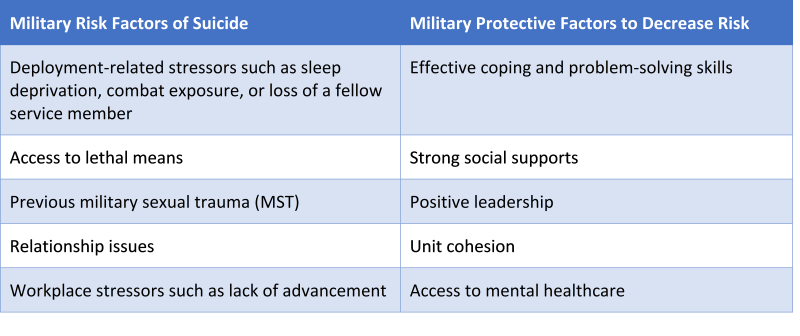
Risk & Protective Factors

While the rate of suicide is similar between service members and the civilian population, there are factors unique to the military community that increase the risk of suicide. It is important to not only understand these factors, but also know the protective factors that can decrease these risks.

Suicide Prevention Resources

If you are a service member or military family, connect with a MFLC for local suicide prevention resources. Additionally, here are options for further information and support:


Data-driven Suicide Prevention: Enhancing EAP and Insurer Behavioral Health Program Effectiveness

In today’s fast-paced, high-pressure world, mental health has emerged as a critical public health concern. Suicide, now the 11th leading cause of death in the United States, continues to be a major concern. After a brief decline in 2019 and 2020, suicide rates rose in 2021, with an average of 132 suicides per day—a 5% increase. The situation worsened in 2022, with an additional 3% increase, bringing the average to 135 suicides per day. By 2023, over 50,000 Americans died by suicide, marking the highest number on record. These concerning statistics underscore the importance of integrating targeted suicide prevention strategies into all behavioral health initiatives.

While Employee Assistance Programs (EAPs) and behavioral health benefits from commercial and public insurers provide support for individuals facing mental health challenges, these organizations can further strengthen suicide prevention efforts by implementing data-driven systems that proactively manage and mitigate suicide risk, including:

  • Early identification—Preventing crises before they escalate is critical. Utilizing predictive analytics, organizations can identify early warning signs and intervene promptly.
  • Ongoing assessment—Continuous mental health monitoring allows care to be adjusted and personalized as needs evolve.
  • Proactive outreach—At-risk individuals often don’t seek help on their own. Through population engagement tactics, such as targeted emails, app notifications and direct outreach by care managers trained in suicide prevention, organizations can ensure timely support reaches those in need.
  • 24/7 supportive care—Round-the clock access to support is vital for effective suicide prevention. On-demand resources like digital tools for mental health and wellbeing, educational materials, safety plans, hotlines, crisis text lines and direct connections to mental health professionals provide individuals with the help they need, whenever they need it.
  • Specialized care management—Licensed clinicians trained in mental health services and evidence-based practices have the expertise to deliver essential support to at-risk individuals, including designing individualized care plans to enhance protective factors, such as building social support networks and improving problem-solving skills and using ongoing remote monitoring to adjust and personalize interventions as needs evolve.
  • Sub-specialty networks—Access to clinicians specializing in mental health conditions ensures at-risk individuals receive the focused care they need. Also, subspecialty medical clinics and primary care providers should screen for mental health conditions. Some physical health conditions (e.g., traumatic brain injury and cancer), can carry a risk of suicide.
  • Outcomes and data-driven approach—Using data to measure the effectiveness of suicide prevention programs allows organizations to continuously refine their strategies, ensure efficient use of resources and better target interventions.

Integrating data-driven targeted suicide prevention and risk management strategies can significantly enhance the effectiveness of EAP programs and behavioral health benefits provided by private and public insurers. Early detection of warning signs and timely interventions can reduce the risk of suicide, save lives and foster a healthier, more resilient society.

Learn how Magellan Healthcare’s data-driven approach is helping organizations safeguard lives here.

Sources:


The Lyrics of Our Emotions

Exploring Music in Non-Medical Counseling Sessions


Music has a long history within the military as a method of addressing morale. The consistently positive response to music has led to research seeking to determine if it can be used in a therapeutic approach for Service members. (Gooding & Langston, 2019) Although music exploration is often associated with soothing melodies and uplifting lyrics, it also provides a valuable opportunity to explore and address negative emotions through music. This is because the exploration of negative emotions via music helps normalize and transform them into something healthier. Service members often train themselves to compartmentalize negative emotions in intense situations and can sometimes have difficulty engaging with emotions. This can lead to a sense of emotional blunting where the individual is aware that they have emotional discomfort but are unable to express the depth of their emotion or engage it in a way that allows effective processing. Listening to music is an activity that can assist individuals with emotional expression and establish coping skills. From creative expressions to the increasing availability of “rage rooms,” we are seeing an increase in techniques that utilize external expression, not just internal dialogue. Here are a few reasons why you may want to incorporate music in your next non-medical counseling session.

Music Can Facilitate Emotional Expression

An “emotion” playlist can be an example of this outward expression. Encouraging an individual to develop a list of songs they associate with certain feelings can assist in creating a safe space for them to experience said emotions. Studies have shown a correlation between music and brain activation in regions associated with emotion, reward, and cognitive processes (Fuentes-Sanchez, 2021). By utilizing a format that is designed to evoke specific emotions, we can provide clients with a way to feel more comfortable in emotional engagement. This method can be effective in situations where the individual states difficulty describing their emotions, feels that they have difficulty feeling emotions to the same extent as others, or describes an emotional numbness that feels inappropriate to them. By providing a structure or atmosphere where a specific emotion is being portrayed, it gives an experiential example that can limit some of the risks that accompany vulnerability.

Music Encourages Introspection

Listening to music in a safe space allows people to, in effect, practice their emotions. A recent study with the U.S. military utilizing a phased music exploration included lyric analysis as a prompt for introspection of life circumstances. Participant comments included “moving forward emotionally,” “I found something in me that was lost.” (Vetro-Kalseth,2021, p.449) While this study included a focus on songwriting, it does provide an illustration of how we connect emotionally with music. Hartman and Conklin (2009) state that songs can be “a medium where feelings, emotions, values, dreams, fears, and hopes are expressed” and can assist those who are unable to express “eloquently and succinctly to discover and express something about their true self through the use of that music’s lyrics” (p.50).

Music Opens Lines of Communication

Music can facilitate communication by allowing individuals to process their feelings, become comfortable with emotional expression, and learn to recognize their own emotions more clearly. Writing lyrics is a unique expression of emotion that allows the Service member to creatively capture thoughts or feelings, which can be cathartic.

Additional benefits of incorporating music into a non-medical counseling session include being able to limit the time of a playlist, being able to arrange an appropriately supportive environment, and being able to have more say in when those emotions can be addressed safely. This can help prevent emotional overflow in situations that would be damaging or dangerous to the client. Music exploration is not a solution for everyone, but it’s a great alternative to try for Service members and military families.

References

Gooding, Lori F.; Langston, Diane G.; Journal of Music Therapy, Vol 56(4), Win 2019 pp. 315-347. Publisher: Oxford University Press; [Journal Article]; DOI: 10.1093/jmt/thz010, Database: APA PsycInfo

Fuentes‐Sánchez, Nieves; Pastor, Raúl; Escrig, Miguel A.; Elipe‐Miravet, Marcel; Pastor, M. Carmen. Psychophysiology. Sep2021, Vol. 58 Issue 9, p1-17. DOI: 10.1111/psyp.13884. , Database: SPORTDiscus with Full Text

Hartman, Nathan S.; Conklin, Thomas A. Organization Management Journal (Palgrave Macmillan Ltd.). Spring2009, Vol. 6 Issue 1, p48-57. 10p. 2 Diagrams, 3 Charts. DOI: 10.1057/omj.2009.7. , Database: Business Source Ultimate

Vetro-Kalseth, Danielle; Vaudreuil, Rebecca; Segall, Lorna E. Military Psychology. Nov/Dec 2021, Vol. 33 Issue 6, p446-452. 7p. DOI: 10.1080/08995605.2021.1962194. , Database: Military & Government Collection


Overcome thoughts of suicide and take care of your mental health

September is Suicide Prevention Awareness Month. Sometimes, suicide may seem like the only way to escape the pain of situations such as a breakup, job loss, social exclusion, bullying or other trauma. This type of distress can be a dangerous trap. It’s vital to take immediate steps to move yourself away from feelings of hopelessness. What can you do?

Spot the triggers. Recognize worsening distress in the form of self-blame, poor self-esteem, rejection, loss of interest in activities or feeling trapped and hopeless.

Remove lethal items. Rid your home of items you could use for self-harm, like guns, knives, razors or expired, discontinued and non-essential medicines.

Get help right away. Acting quickly can make all the difference. Call or text 988 for the Suicide & Crisis Lifeline. A trained counselor will help you talk through what you’re feeling, and together you’ll develop a safety plan.

Consult with a professional. Mental health professionals can help you with concerns like depression, anxiety and suicidal thoughts.

Reach out. Talk with a close friend, loved one or spiritual advisor. If you feel you’re in a crisis, dial 911.

Recognize feelings are temporary. Your dark feelings aren’t permanent. With responsive care, you can and will feel better.

For more on suicide prevention, visit our website for September Suicide Prevention Awareness Month, MagellanHealthcare.com/Prevent-Suicide, and be sure to check out the suicide prevention tip sheets and awareness campaign toolkit.

SOURCES: Mayo Clinic and Mental Health America