1

Giving Back to Caregivers During the Holidays

When you think about giving back this holiday season, remember those persons serving as caregivers for the loved ones in your life.  Caregiving is one of life’s highest honors, but on the flip side it can also be physically and emotionally draining, especially during the holidays.  The added stress of having to balance holiday activities like shopping and visiting relatives and friends with caregiving responsibilities can be overwhelming, and may leave caregivers feeling frustrated, isolated, depressed and exhausted.

Caregiving today affects almost everyone – over 43 million adults in the United States have provided unpaid care to an adult or child in the past 12 months.

Bring a little joy to the world

There are a number of things you can do to help ease the burden for the caregivers in your life.  Here are some suggestions:

  • Ask how you can help – This is the simplest approach. Begin by recognizing the caregiver’s role and ask about her or his concerns during the holiday season.  If you encounter resistance because the caregiver doesn’t feel that responsibilities can be set aside, make some suggestions about ways you can help without causing more stress.  For example, you could talk about family activities –are they able to attend, is the timing convenient, is there something you could do to help them prepare?
  • Provide respite – Caregivers have their own holiday tasks to accomplish and more importantly, they need time to take care of themselves.  You could sit with a loved one for a few hours or help schedule in-home care for a period of time.  Perhaps spending time with the caregiver is the break they need.  Get together for coffee and companionship.
  • Offer your services – With numerous responsibilities, there are bound to be a few things on the back burner that you could help a caregiver with.  Ask about needed home repairs, installing equipment to make their life easier or making a trip to the store or post office.  Could you assist with shopping or addressing holiday cards and getting them in the mail?
  • Simplify traditions – Just because you’ve always done something doesn’t mean that the tradition must continue exactly as it was. Adapting activities to make them less stressful – and more enjoyable – is a win-win for everyone involved.  Plan ahead to ensure the space and timing is conducive. Something as easy as eating earlier in the day could benefit transportation arrangements, or keep caregiving needs on schedule.

Don’t limit recognition of the caregiver to the holidays.  The fact that you care enough to recognize the unique situation, the work performed, and to reach out may be enough to give the caregiver joy.  A burden shared is a burden lightened.

Keep up the good work

While holiday stress happens once a year, family caregivers are at an increased risk for burnout, depression, substance abuse, chronic illness and a host of other maladies year round.  In addition, there are a variety of caregiving situations that require special support, including long-distance caregiving and those caregivers in the sandwich generation who are caring for parents and their own children at the same time.

Check out the following tips and resources to see how you can support caregivers:
Long Distance Caregiving 

The Sandwich Generation

Finding and Choosing Respite Care Services

Caring for the Caregiver

10 Fast Facts About Caregivers


Medicine Cabinet Minefield: How old prescriptions drugs are fueling an opioid addiction crisis

Opioid addiction kills thousands of people every year. In 2014, for example:

Despite these shocking numbers, the problem continues to grow. (It quadrupled in the first decade of this century and continues to explode). In the past twelve months, the Drug Enforcement Administration (DEA) has been forced to issue new warnings on drugs such as fentanyl, a potent opioid more than 100 times more powerful than morphine and 30-50 times stronger than heroin. While fentanyl has killed thousands of people over the past few years, many only heard of it recently, when it was attributed to the death of the musician Prince.

Close to Home: Opioid Addiction from Prescription Sources

Given the dangerous nature of some of the most common prescription painkillers—not just from concerns about addiction but from accidental and intentional overdose (the leading cause of accidental death)—it may be surprising to find out just how common it is to find opioid medications in the home.

In 2012, the Centers for Disease Control (CDC) calculated that healthcare providers wrote 259 million prescriptions for opioid painkillers. That is enough for every American adult to receive a bottle of pills.

While there have been efforts to reduce the number of prescriptions written, the number of prescriptions remains very high and the volume of opioid medications already distributed is also alarming.

And this is a key contributor to the opioid addiction crisis. According to the CDC, most people who abuse prescription opioids get them for free from a friend or relative. Essentially, people give their old prescribed medications to friends or relatives. Or, alternatively, abusers take old prescription pills from friends and relatives without their knowledge.

Even among the people at the highest risk of overdose (using prescription opioids non-medically 200 or more days a year) a friend or relative’s medicine cabinet is a common source of finding opioid medications. Among that population:

Cleaning Up: Reducing the Availability of Prescription Opioids

Since the early years of the decade, state and federal authorities have made a concerted effort to reduce the regularity by which opioid medications are being prescribed. In particular, there has been a focus on reducing the ability of abusers to use multiple prescribers to issue painkillers.

Several states have achieved various degrees of success. In New York, the number of patients seeing multiple prescribers for painkillers was reduced 75% percent between 2012 and 2013 after prescribers were required to check the state’s prescription drug monitoring program before issuing a prescription.

In the same time-frame, Tennessee saw a 36 percent reduction in the number of patients seeing multiple prescribers for painkillers when it instituted a program similar to New York’s.

Florida saw a 50 percent reduction in oxycodone overdose deaths between 2010 and 2012 after it regulated painkillers and stopped providers from issuing painkillers from their offices.

In addition to programs aimed at healthcare providers, the Federal government has directed resources towards educating consumers about disposing prescription opioids and other medications. The Food and Drug Administration provides information on the safe disposal of painkillers such as Fentanyl patches. The Drug Enforcement Administration is also providing information for the public regarding disposal as well as created a program to authorize and register drug disposal collectors.

A Pioneer in Substance Use Management

Magellan Health is a pioneer in offering integrated, comprehensive opioid risk and substance use management programs. We have an unyielding commitment to ending the current epidemic. And we are uniquely positioned to bring together behavioral, medical and pharmaceutical programs to positively impact overall population health and reduce cost.


Part 2: Magellan Open Vision Exchange (MOVE) 2016 Recap

Uncertainty is the name of the game for many industries today, including healthcare. With rapidly emerging technologies, regulations and changing consumer demands, companies must manage differently in order to keep up. Jeff Dyer, innovation visionary and co-author of the highly acclaimed, The Innovator’s DNA and its follow-on publication, The Innovator’s DNA: Mastering the Five Skills of Disruptive Innovators highlighted the threat to many companies today – predicting that 50 percent of the S&P 500 will be replaced over the next 10 years.

Human-Centered Innovation

As consumer experiences across nearly every industry become more personalized, on-demand and targeted, he encouraged pushing our thinking beyond meeting functional needs by looking at social and emotional ones as well. By doing so, companies are able to identify unmet needs that can be catalysts for more useful solutions that ultimately win in the market.

The GE Adventure Series Scanner, an MRI scanner designed for children to make scanning a less frightening experience, was a prime example shared of human-centered innovation. While advanced in functional features, what was discovered through observing young patients getting a scan was that the former machine was intimidating – the designer learning that as many as 80 percent of pediatric patients had to be sedated in order to sit still long enough for the scan.  Witnessing this, a new approach was taken, ultimately applying human-centered design methods to redesign the experience as a series of “adventures” for children, delighting and no longer scaring its young users.

The Big Picture in Quality Care

While human-centered innovation can be applied product by product and interaction by interaction, we heard another thought-provoking point from the day’s presentations – that it’s really hard to detect poor quality care through one interaction. The path to a poor outcome most likely includes bouncing from doctor to doctor and breakdowns in coordination and communication between interactions. Often, the big picture reveals the flaws.

The reality today is that many people still get prescriptions from multiple, independent physicians, and many hospital admissions come with undiagnosed behavioral health concerns. The healthcare system has an immense opportunity to come together around the whole patient and to better identify needs at a population level to deliver on value-based care that leads to healthier outcomes.

Physician Collaboration

Our physician panel sparked further ideas in how to collaborate with PCP’s, nurses and other care workers to better meet patients’ needs. Often at the front lines of the patient experience, creativity in finding unidentified needs was discussed as pivotal to creating an effective healthcare experience. While concepts of self-directed, consumer-focused healthcare and increasing consumer participation in healthcare decisions have become popular, the role of physicians is also being transformed. Their responsibility is increasingly to supplement and put into perspective available information, manage expectations, and instill confidence. The discussion thus encouraged leveraging physicians as “natural, trained problems solvers”, bringing them into the ideation for a better patient experience, and empowering them with action-oriented data and decision support along the way.

We thank all of our leaders, clients and partners for joining us in a memorable and energizing event. We look forward to our next gathering in January 2017.


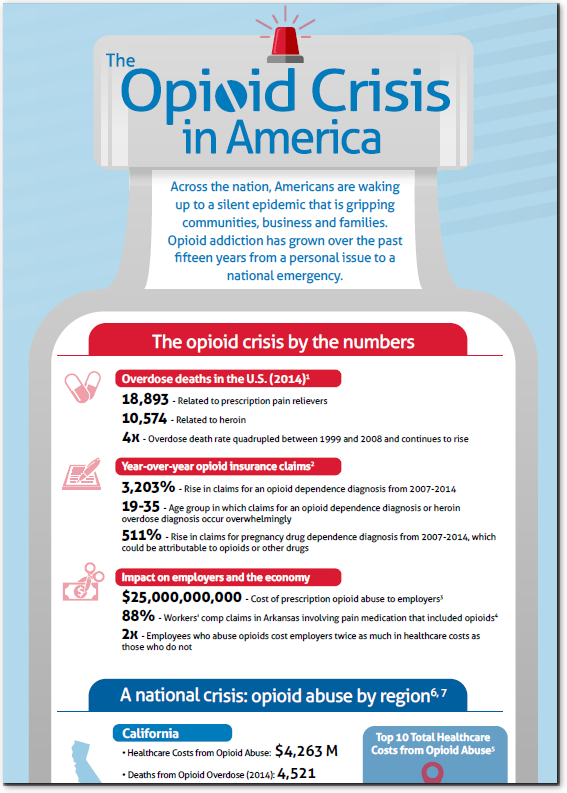
See the impact of opioid addiction in this new infographic

Opioid addiction has grown over the past fifteen years from a personal issue to a national emergency. A new infographic from Magellan Healthcare reveals the devastation that this epidemic is causing.

  • In 2014, there were 18,893 overdose deaths related to prescription pain relievers
  • There was a 3,203% rise insurance claims for opioid dependence diagnosis from 2007-2014
  • Prescription opioid abuse is costing employers $25,000,0000 a year

Infographic SnapshotThe opioid addiction crisis is causing such an unprecedented amount of harm precisely because it is such a complex, multi-faceted issue. Those looking for answers as to how such an epidemic could have happened, will need to examine a swath of individual problems, including:

  • The enormous quantity of prescription opiates
  • The limited patient knowledge of opiate risk
  • That diversion of opiates to family and friends is so common that only 20% of those with opioid abuse problems are actually using opioids prescribed to them
  • The struggle to adequately assess patient’s substance use history and risk of addiction when prescribing opiates
  • The lack of clear guidance as to who should receive opiates and for how long
  • The difficulty in maintaining patient adherence to withdrawal management treatment plans.

New solutions are needed to tackle each of these individual issues. At Magellan Health, we intend to do precisely that. The opioid addiction crisis has already taken a huge toll and it grows worse every day. It is manifesting itself in myriad ways among thousands of communities across the nation. At Magellan Health, we have an unyielding commitment to ending this epidemic.


Person-first language: It’s time to bring healthcare into the 21st century

Written by Thomas Lane, NCPS, CRPS

What’s in a word? Much more than many of us realize.

In the context of behavioral health, substance use and even physical health challenges, using terms and phrases that group people by diagnosis, disability, disease and other characteristics perpetuates stigma, discrimination and exclusion. Yet this type of language has been part of the healthcare lexicon for decades. Outdated terms such as “addict,” “crazy” or “diabetic” are just a few common examples.

We live in a time when individuals are at the center of the healthcare field. As healthcare consumers, individuals are empowered to make their own health choices. As healthcare professionals and activists, we need to mirror this empowerment, and seize the opportunity to pivot how we portray what we do. We need to move away from archaic language that contradicts all of the positive changes we help individuals make in their lives on a daily basis.

This is where “person-first language” can make a big difference.

What is person-first language?

Person-first language means seeing people as “people first,” and not as their disease, illness or disability, or as part of a homogeneous group. It portrays individuals living with behavioral health, substance use or physical health challenges beyond a lens of illness, diagnosis and hopelessness. It helps address issues relating to illness-identity and self-stigma, keeping in mind that we are all unique individuals, with unique lived experiences.

At Magellan Health, our use of person-first language stems from our work in behavioral health, but it applies to everything we do with equal emphasis. It shows our commitment to being culturally and linguistically appropriate in all of our communications. It models our principles of recovery and resiliency, and contributes to evolving and improving our organizational culture.

On a personal level, as an individual in recovery myself I can tell you how important person-first language became to me as I discovered the often unintended consequences of using language that robs one of their individuality. We all deserve respect and appreciation for our unique qualities.

How is person-first language used?

Using person-first language is an intentional practice. Here are some examples of old language that is commonly used in comparison to newer, person-centered language that can be applied by anyone:

  • From “chronic disease management” to “improving health outcomes for people living with chronic health conditions.”
  • From “illness self-management” to “improving health education, support and community inclusion to promote individual wellness and self-direction.”
  • From “crazy, nuts, lunatic” to “someone who may benefit from services and supports.”
  • From “individuals suffering with a mental illness” to “individuals with a mental illness.”

For practice, try to recognize when others use the outdated or inappropriate terms and phrases above. And ask yourself how often you use them. Then, make the conscious choice to omit them from your vocabulary and replace them with new terms. While changing an old habit can be a challenge, consciously developing a new one is an easier path to meaningful change.

Remember, we all have choices about the words we speak and write. Those choices can either affirm the distinctive individuals that we are — or diminish us with labels. The words we use can fill us with hope, or burden us with despair. So let’s choose hope.

Changing the way you speak and write is a gradual process. But by putting the person first when you do, you can play a role in bringing our healthcare language into the 21st century.

For more information and resources, please visit Magellan’s e-Learning Center: http://www.magellanhealth.com/training-site/home.aspx


October is Substance Abuse Prevention Month

Magellan Health marked October as Substance Abuse Prevention Month, with its chief medical officer, Dr. Karen Amstutz, releasing the following statement:

“Substance abuse does not discriminate. It pays no mind to gender, race, age or income level. According to the National Institute on Drug Abuse, the abuse of alcohol, tobacco and illicit drugs costs the United States more than $700 billion annually related to crime, lost work productivity and healthcare. Substance abuse, and in particular, our nation’s opioid epidemic, is gripping families and communities all across the country. Chances are, you know someone who is coping with substance abuse, though they might be doing so in silence.

“Magellan Health has worked in the field of behavioral health management for over 40 years, and we believe strongly that the treatment of substance abuse, including opioid misuse and addiction, is possible. Magellan Health advocates for medication assisted treatment (MAT), a well-researched and highly effective approach combining medication to treat the physical effects of opiate dependence, with counseling and recovery support services. Magellan Health is poised to support treatment professionals, legislators, third-party payers and patient advocates in the implementation of prevention efforts, best clinical practices, and elimination of potential barriers to treatment and recovery. Working together, it is important to shine a light on this dark epidemic and provide hope to people seeking to live a healthier, more vibrant life.

“If you or someone you know is dealing with substance, please call the Substance Abuse and Mental Health Services Administration’s Help Line at 1-800-662-HELP (4357). For Magellan’s resources related to substance abuse, please visit http://magellanhealthcare.com/opioids“


Autism’s Impact

1 in 68*. It’s not the number – it’s the impact.

Increasing prevalence and high treatment costs make providing quality care and supportive services for children with autism and their families more important than ever.  Many families struggle to obtain access to appropriate autism services.  Providing care for a child with autism can be challenging and can create significant stress impacting a caregiver’s health and even their productivity at work.

Autism Connections from Magellan Health on Vimeo.

Employers are feeling the impact. 

Balancing life’s demands is hard enough, but for parents of children living with autism, it can impact their productivity and lead to lost time at work.

To retain these valuable employees, increase productivity and decrease benefit costs for issues such as stress, depression and even physical health challenges, it’s critical that employers and health plans develop solutions to help address their needs.

Autism Connections

Our industry-leading Autism Connections program provides children and their families with the support they need to navigate the complex healthcare system, enhanced care coordination, access quality providers and receive support both for themselves and their children.

Please view the video above to learn more about this program and our specially trained, caring and supportive clinical specialists in our Autism Center of Excellence.

*The Centers for Disease Control and Prevention (CDC) estimates that 1 in 68 children in the United States has been identifi ed with autism spectrum disorder (ASD). March, 2014.

Sources: CDC Data and Statistics on Autism, 2014; Autism Fact Sheet, National Autism Association, 2013; The Autism Society, 2013; Autism Speaks, 2013; National Business Group on Health: Therapies for Children with Autism Spectrum Disorders, May 2012, p.1.


September is Suicide Prevention Awareness Month

Magellan Health marked September as Suicide Prevention Awareness Month, with Barry M. Smith, chairman and chief executive officer of Magellan Health, and Sam Srivastava, chief executive officer of Magellan Healthcare, releasing the following statement:

“Suicide produces a ripple effect through communities of friends, family, loved ones and co-workers, and its effects are devastating. There are people in our own communities, too, who have attempted suicide and may be coping with the after-effects of their decision, both physically and emotionally.

“Magellan Health has long believed that suicide should be a ‘never’ event, and that even one suicide is one too many.

“Consider these facts:
• Every 13 minutes, someone dies from suicide in the United States.
• Suicide is the second leading cause of death in the military, with roughly 20 veterans each day committing suicide.
• For each suicide, six other people are directly impacted.
• Ninety percent of individuals who die by suicide have experienced mental illness.

“During Suicide Prevention Awareness Month, and always, we each have an obligation to extend a hand to individuals at risk, as well as to their families, and the five million survivors of suicide living among us.

“If you or someone you know is considering suicide, please call the National Suicide Prevention Lifeline at 1-800-273-TALK (8255).”